Esperanza
Like Water for ChocolateEsperanza is Rosaura and Pedro’s daughter, and her life becomes the point at which an inherited family obligation can either repeat itself or end. Born prematurely after her mother’s condition required an emergency operation, she is Rosaura’s only child and, under the De la Garza custom, the daughter expected to remain unmarried and care for her mother. Tita helps raise her while resisting that prescribed future; ultimately, Esperanza marries Alex, and Tita’s efforts give her a life beyond the role assigned to her at birth.
Identity and Early Circumstances
Esperanza’s arrival follows Rosaura’s difficult pregnancy and the loss of her mother, Mama Elena. Rosaura’s grief brings on the birth, and complications involving the placenta make surgery necessary to save her life. The operation leaves Rosaura unable to have more children. As a result, Esperanza is both her only child and the youngest daughter: precisely the position that, according to family custom, would make her responsible for caring for her mother for life.
The custom had already shaped Tita’s prospects. When Pedro sought to marry Tita, Mama Elena rejected the possibility on the ground that the youngest daughter had to stay home and serve her mother. Tita questioned the rule’s fairness and logic, but the family expected obedience. With Esperanza, the same demand threatens to pass from one generation to the next, now voiced by Rosaura rather than imposed by Mama Elena.
Tita asks that the baby be named Esperanza rather than Josefita, a name Pedro proposed that would have repeated Tita’s own name. Tita does not want a name to dictate the child’s destiny. Her concern is sharpened by the family’s circumstances: if Rosaura’s view prevails, Esperanza will grow up with no prospect beyond remaining at her mother’s side. Tita hopes that Rosaura will not revive the old custom, and chooses a name that does not bind the child to a repetition of her aunt’s life.
Childhood in Tita’s Care
Rosaura’s recovery and inability to nurse leave Tita with much of Esperanza’s daily care. Tita does not become her wet nurse as she did for Roberto, having learned from that earlier attachment how painful separation can be. Instead, she feeds Esperanza gruels and teas, following the kind of nourishment Nacha once prepared for Tita. The care is practical, but it also creates a close bond between aunt and child.
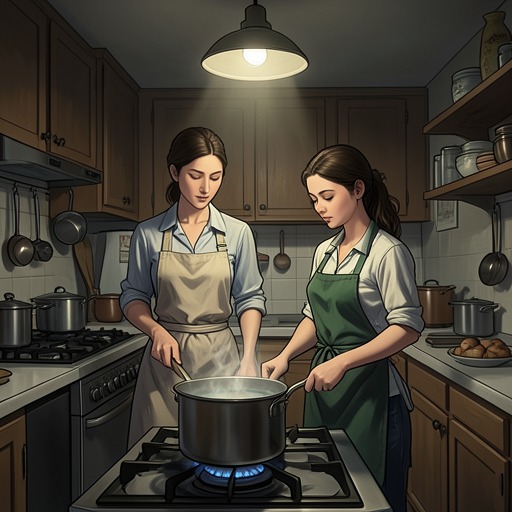
The kitchen becomes the setting of Esperanza’s early life. She spends much of the day there with Tita, growing healthier among its warmth, smells, and food. When Rosaura later insists that her daughter be brought back to her room and kept away from the kitchen, the change proves difficult: Esperanza cries when she is separated from the familiar warmth. Tita carries the stew she is preparing upstairs so its heat and smell can settle the child, then returns the heavy pan to the kitchen. This episode makes visible how thoroughly the kitchen has become part of Esperanza’s sense of comfort, and how much of her ordinary care Tita provides.
Tita’s attachment is not only domestic. She remembers feeding Esperanza bean broth with a little silver spoon, watching for the child’s first teeth, and taking care not to hurt them. She also worries that Rosaura, who has not done these tasks herself, may not know how to bathe, dress, soothe, or comfort her daughter. Yet Tita recognizes the cost of her own closeness: if she remains in the household and continues to grow more attached, she risks another painful loss like the one she experienced with Roberto. The child is not hers, and the family could send her away. That vulnerability helps explain why a future with John Brown, who offers Tita the prospect of a family of her own, holds such appeal.
The Inherited Duty and Tita’s Resistance
Rosaura makes the custom explicit when Alex, John Brown’s young son, sees Esperanza and says he wants to marry her when they are older. Rosaura explains that this cannot happen because Esperanza is destined to care for her until she dies. Tita is appalled that her sister would impose on her daughter the same restriction that had governed Tita’s own life. The scene sets the child’s imagined future in sharp contrast with the innocent possibility of marriage Alex expresses.
Rosaura later relies on Esperanza’s supposed obligation as her consolation when she fears Pedro may leave her. She insists that at least her daughter is bound to stay with her forever. When Tita confronts her, Rosaura says she will feed Esperanza herself and forbids Tita from feeding the child, accusing her of being a bad influence. Tita, in turn, refuses to accept that her niece should be forced into the old custom. Their conflict is therefore not simply over who performs a daily task: it concerns whether care will be a relationship sustained by affection or a duty used to restrict a child’s future.
The eventual agreement between Rosaura, Pedro, and Tita gives this conflict a formal, if uneasy, structure. Rosaura wants the appearance of a successful marriage and a family in which her daughter grows up; Tita and Pedro agree to keep their relationship secret and not have a child outside that arrangement. In return, Rosaura will share Esperanza with Tita: Tita is to feed the child, while Rosaura is responsible for her education. The terms also require Rosaura to live with them amicably and avoid jealousy and complaints. The arrangement permits Tita’s daily closeness to Esperanza, but it does not immediately remove Rosaura’s claim that her daughter must remain unmarried.
Education, Courtship, and Change
Rosaura initially opposes sending Esperanza to school. She imagines that the girl’s future lies in caring for her mother and believes that piano, singing, and dancing will better prepare her to entertain Rosaura and make an impression at social gatherings. Pedro and Tita argue that Esperanza should attend school. After three conversations, they persuade Rosaura to agree, partly by convincing her that school will help the girl converse and mix with the leading families of Piedras Negras. Esperanza attends the best school available to her, while Tita supplements that education with what she has learned about love and life in the kitchen.
As the years pass, Esperanza and Alex meet again at a school party. Alex, now finishing medical school, and Esperanza are immediately attracted to one another. Esperanza confides in Tita about the force of her response to him, and Tita recognizes the depth of the connection. She is the first to learn that Alex is courting her niece. Their courtship brings the family’s competing claims into the open: Rosaura opposes the match, while Pedro and Tita support Esperanza’s wish to marry.
Rosaura argues that the couple have violated their agreement and fights to preserve what she regards as her right to keep her daughter. Their dispute lasts three days, intensifying into a household conflict. Rosaura then dies after years of severe digestive problems. Her death removes the immediate obstacle to Esperanza’s marriage and ends the demand that she remain her mother’s lifelong caregiver.
Marriage and Narrative Significance
Tita regards the wedding of Esperanza and Alex as her greatest triumph. She sees her niece as self-confident, intelligent, well prepared, and happy, qualities that stand against the narrow future Rosaura had planned for her. Esperanza appears in her wedding gown and dances with Alex to the waltz The Eyes of Youth. The wedding marks more than the formation of a couple: it confirms that the family’s youngest-daughter rule has not determined Esperanza’s adult life.
Esperanza’s story is shaped by kinship in several forms: she is Rosaura’s daughter, Tita’s beloved niece and daily companion, and Alex’s chosen partner. The family arrangement once makes her future seem to belong to her mother, while Tita’s care and advocacy help her claim an education and a marriage of her own. Her ending answers the earlier image of the child destined to serve indefinitely: the expectation is not passed on unchanged, and the life denied to Tita becomes possible for the next generation.